The hardest thing you'll do today is nothing.
We took staring at a wall extremely seriously,
so you don't have to.
We took staring at a wall extremely seriously,
so you don't have to.
The reason a blank wall feels impossible isn't a lack of willpower. It's two mechanisms working against you, and both of them reverse.
Your brain hasn't run out of room. The real cost is switching: every notification shuts one circuit down and fires up another. A few hundred times a day, and the most basic tasks become physically impossible.
After years of easy hits, your brain turned its own dopamine sensitivity down. Now boring-but-important can't compete with a device engineered to win. That's the muscle that atrophied. It grows back when the flood stops.
Prescribed treatment: the most boring object we could find. A wall.
No account, no setup, no homework. Prop, sit, stare — the wall takes it from there.
Stand it where the wall meets the floor, or on a desk facing you. Then sit down.
Pick a length. Get comfortable. Then just look at it. That's the whole exercise.
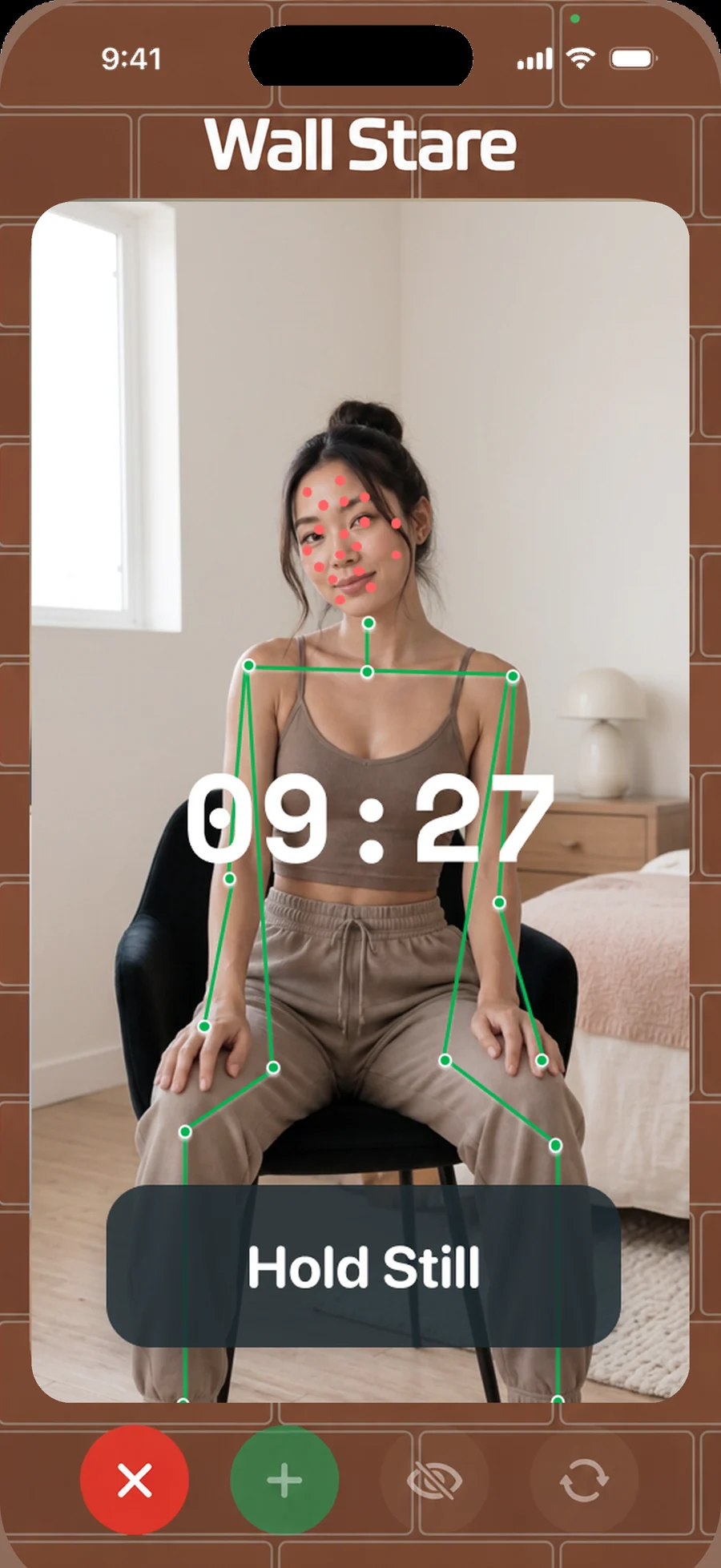
On-device, it reads posture, gaze and fidget, and scores it live. Blink rate joins in 2027.
No video recorded or uploaded. Ever. The wall keeps your secrets — so do we.
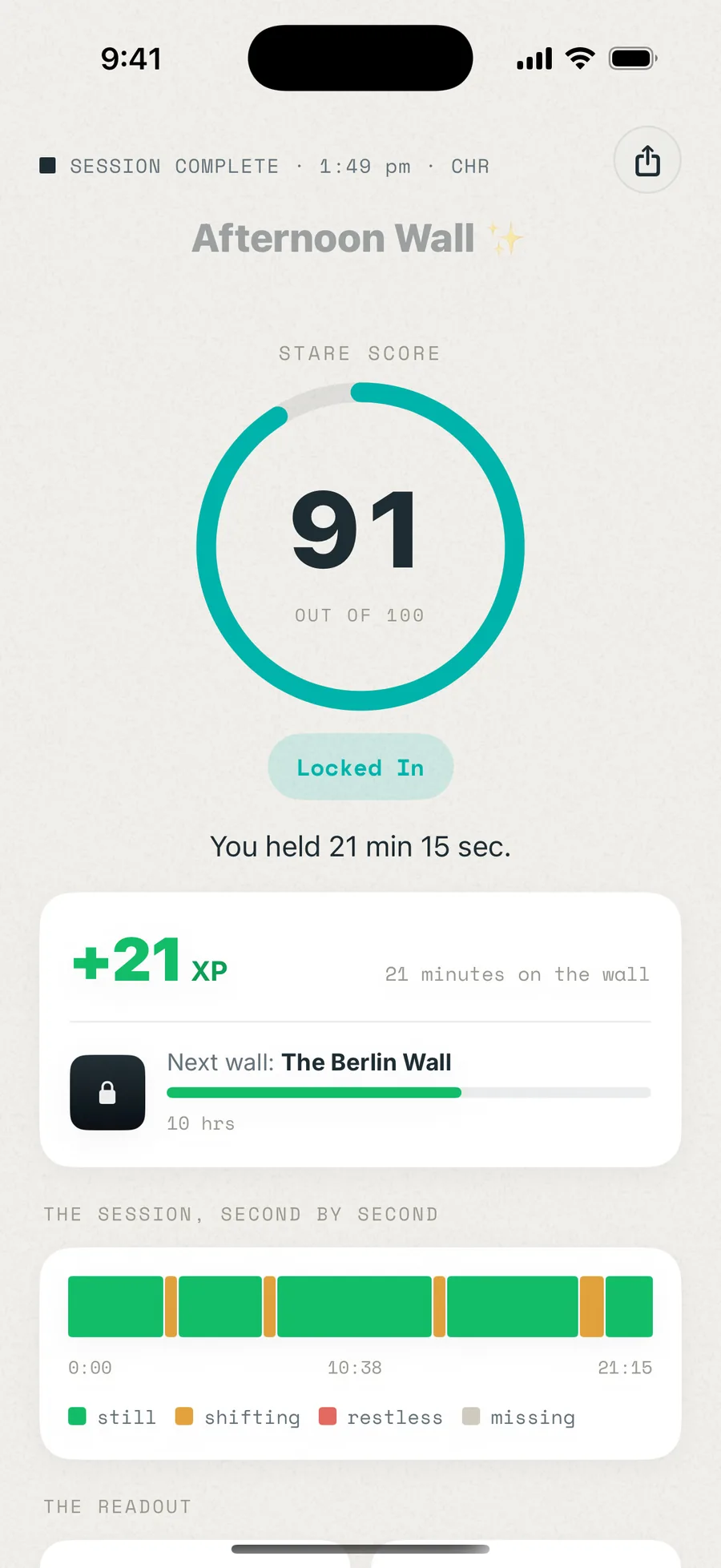
Every session is graded on the tells you can't feel yourself doing. Read straight, like a lab report. Because it is one.
Every time your eyes flee the wall.
Every restless twitch, counted.
The full retreat. Logged and timestamped.
Climbs when you're straining.
The slow collapse over a long sit.
Your record against the wall.
The second the session ends, the wall files its verdict: one number out of 100, a named tier to go with it, the tells that broke it, and what your longest unbroken stare actually means.

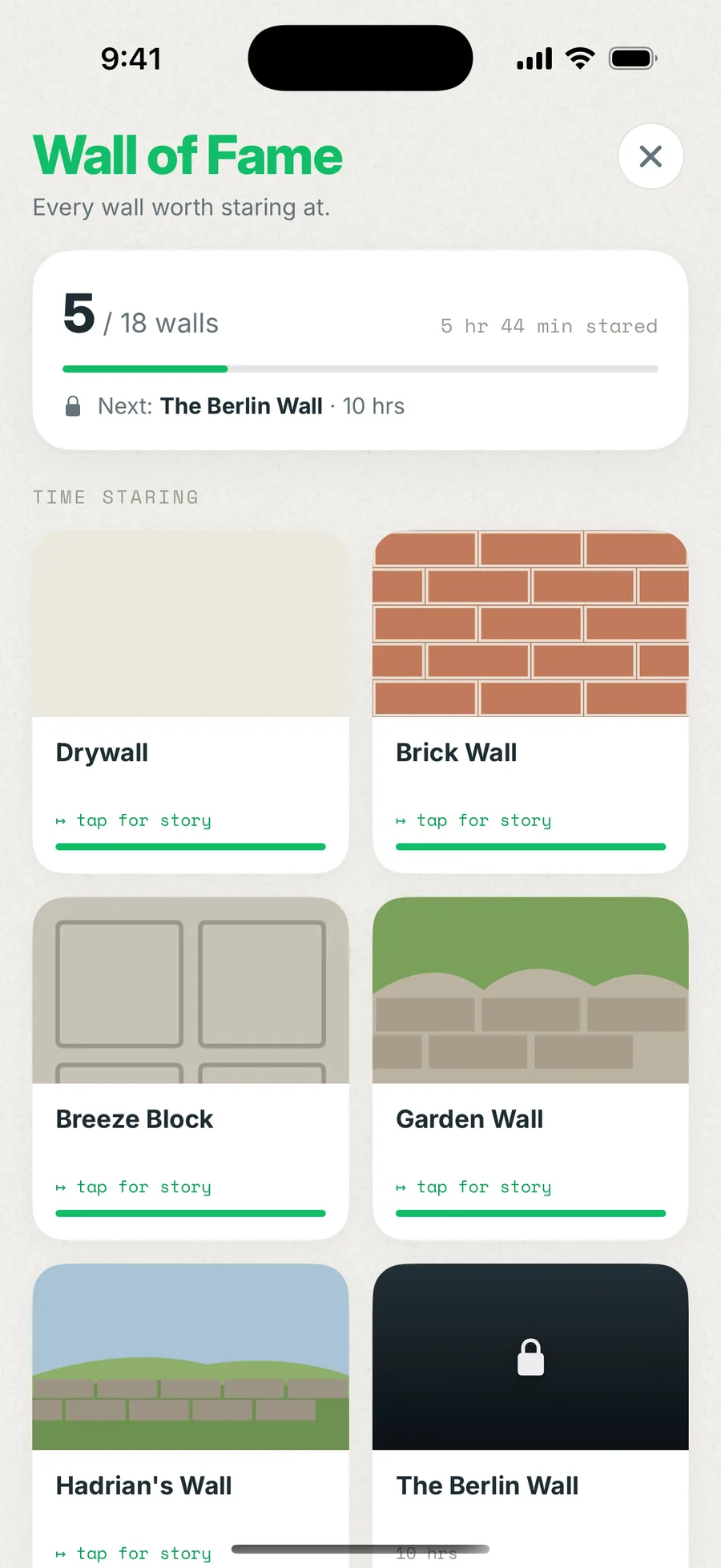
Start on drywall. Earn your way up through the great blank surfaces of history, each with a backstory it absolutely does not deserve. Progression that works from your very first session.

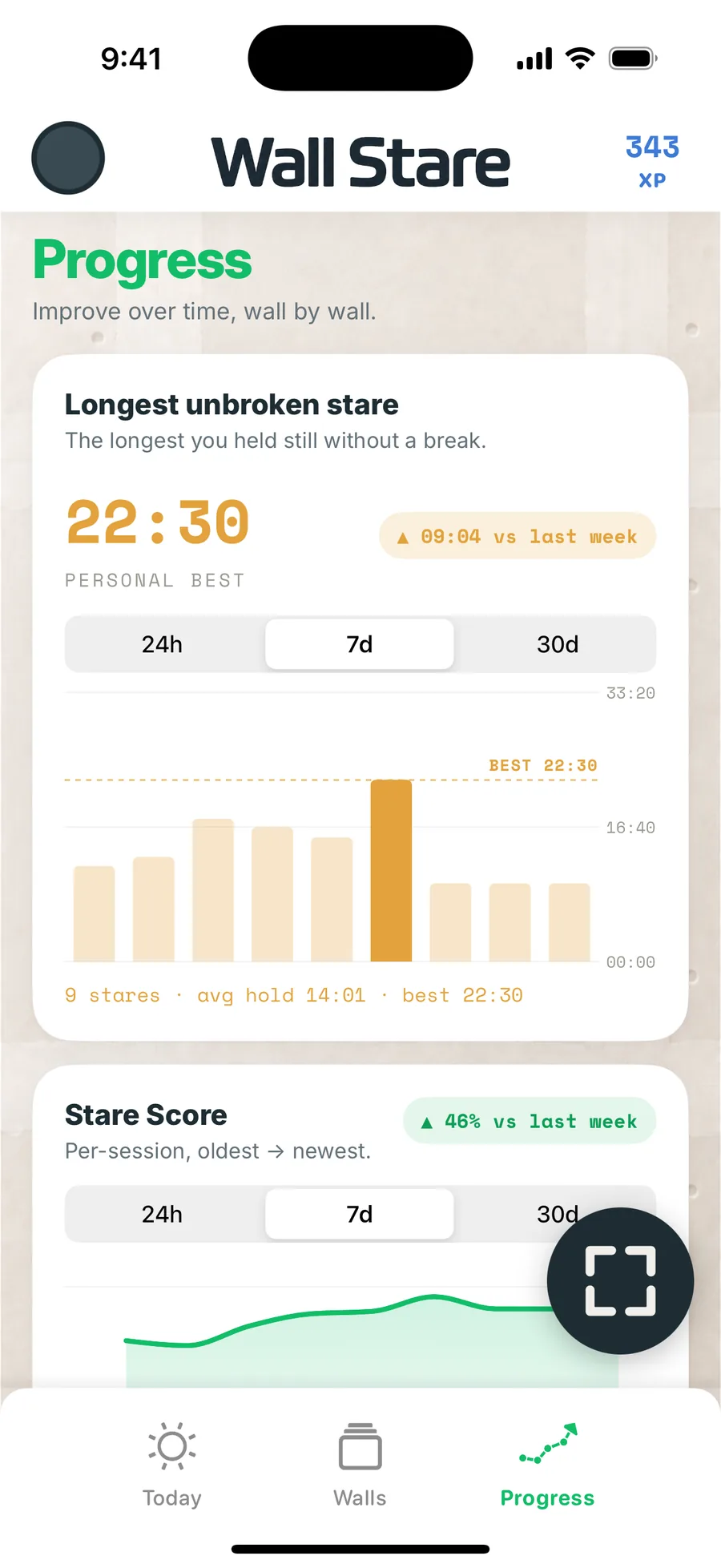
Every sit logs one honest number and plots it against the last. It starts humiliating: most people break at 47 seconds. Then the muscle comes back and the line bends. The wall doesn’t cheer. It records. Somewhere around the eleven-minute mark, it quietly starts to respect you.

Your most distracting apps stay locked until you hit your daily stare goal.
The apps that steal your attention get locked each day until you've hit your staring goal. Open one before then and the wall answers instead.
“Why would you stare at YouTube, when you could be staring at a wall?”
Twenty years of logged measurement. The focus that decline erased is the thing a blank wall trains back.
Average attention on a screen, down from 2½ minutes in 2004.
G. Mark, UC IrvineSingle-point focus produced measurable attention gains in trials.
Mrazek 2013 · Ford & Nagamatsu 2024The session length those trials used. Roughly one stare.
Tang 2007 · Ford & Nagamatsu 2024No cure, no medical claims. Single-point focus — trāṭaka — is one of the oldest attention practices there is; Wall Stare is that, measured.G. Mark, Attention Span (UC Irvine) 2023 · Mrazek 2013 · Ford & Nagamatsu 2024 · Tang 2007. Wall Stare hasn't been independently studied. Neither has the wall.
Stared for ten minutes. Finished my thesis the next day. Unrelated. Probably.
My blinks-per-minute are down 30%. Or will be, in 2027. Either way I feel powerful.
Week one I lasted 41 seconds. The wall and I have an understanding now.
The most terrifying wall of them all. Relax — it's free (for now). No card required.
Most people hold their first stare for about 20 seconds. Everything in here is built to stretch that toward 13 minutes — free of charge. Go beat it.
Free forever? I doubt it.
We would never joke about something this serious. The premise is funny, sure, but the measurements are real and so is the benefit. Both can be true at once. That's the whole design.
Yes, entirely on-device. The front camera reads your posture, gaze and movement to score the session in real time. No footage is recorded, saved, or uploaded. The one exception is opt-in: after a session you can choose to save a photo of your wall, and only then. What happens between you and the wall is strictly between you two.
Stillness is trainable, and attention is the muscle underneath it. A few quiet minutes a day rebuilds your tolerance for doing nothing.
As little as you like. Five minutes counts. Most people settle into ten, and the daily goal is yours to set. You can stop any time; the wall is endlessly patient.
Most first-timers lose to the wall around 47 seconds. A few minutes is respectable. Eleven minutes of unbroken stillness earns the wall's respect — which it does not give easily, and never says out loud.
No catch, no card, no account. You're already paying — in hours, to a feed engineered to win. This gives some of that time back, by rebuilding the one thing the feed quietly took. Free forever? I doubt it. But right now the wall costs nothing, so go stare at it.
iPhone first. Android is staring at the wall, waiting its turn.